
In September 2024, we travelled to Stockholm while we were both still students. Since we were travelling on quite a tight budget, we hesitated before spending extra money on a Stockholm Travelcard. However, after using our 72-hour passes extensively, we felt they were definitely worth it for our trip. That doesn’t mean a Travelcard is essential for everyone visiting Stockholm, though. Whether it’s worth buying largely depends on how often you plan to use public transport.
Is the Stockholm Travelcard worth it?
Before our trip, we researched the attractions we wanted to visit in Stockholm. We quickly realised that many of them were spread across the city, so public transport was going to be important for our itinerary.
We had also planned to buy the Go City Pass for 48 hours. This meant we needed to move efficiently from one attraction to another to make the most of it. The Stockholm Travelcard allowed us to move easily between attractions without having to think about the cost of buying individual tickets each time. Even with the Travelcard, though, we still walked a lot during our trip.
If you’re staying around central Stockholm or prefer exploring mainly on foot, a Travelcard might not offer the same value. In that case, comparing the cost of individual tickets with a Travelcard before buying one would make more sense.
Stockholm Travelcard prices
As of September 2026, adult Stockholm Travelcard prices range from 180 to 470 SEK, depending on the duration of the pass, as shown in the table below.
| Travelcard | Adult Price |
| 24 hours | 180 SEK |
| 72 hours | 360 SEK |
| 7 days | 470 SEK |
Reduced fares are also available, including for eligible students. However, being a foreign student isn’t enough to qualify for the student discount. SL requires a Swedish student identity card carrying the SL logo.
Prices checked on 15 September 2026.
Travelcard vs single tickets: which is cheaper?
A standard adult single ticket currently costs 43 SEK and is valid for 75 minutes. During this time, you can transfer between eligible SL services without buying another ticket.
| Ticket option | Travelcard price | Equivalent single tickets | Travelcard becomes cheaper from* |
| 24-hour Travelcard | 180 SEK | 4.2 single tickets | 5th ticket |
| 72-hour Travelcard | 360 SEK | 8.4 single tickets | 9th ticket |
| 7-day Travelcard | 470 SEK | 10.9 single tickets | 11th ticket |
Based on the current adult single-ticket price of 43 SEK. A single ticket is valid for 75 minutes, including transfers within its validity period. Prices checked on 15 September 2026.
This means that the more frequently you use public transport, the more likely a Travelcard is to be worth it. For example, a 72-hour Travelcard is cheaper than buying nine separate adult single tickets at the current price. However, this doesn’t necessarily mean nine individual journeys, since a single ticket remains valid for 75 minutes and can include transfers.
Which Stockholm Travelcard should you buy?
Choosing the right Travelcard mainly depends on the length of your trip and how often you expect to use public transport.
In our case, we stayed in Stockholm for around four days and had already planned to visit several attractions across the city. We knew we would need public transport frequently, so the 24-hour Travelcard wasn’t long enough for our plans, while the 7-day option was more than we needed. For us, the 72-hour Travelcard made the most sense.
However, visiting Stockholm for three days doesn’t automatically mean you should buy a 72-hour pass. Your choice should depend on your itinerary and how frequently you expect to use public transport. We recommend planning where you want to go beforehand and comparing your expected journeys before deciding which option offers the best value.
Our experience using the 72-hour Stockholm Travelcard

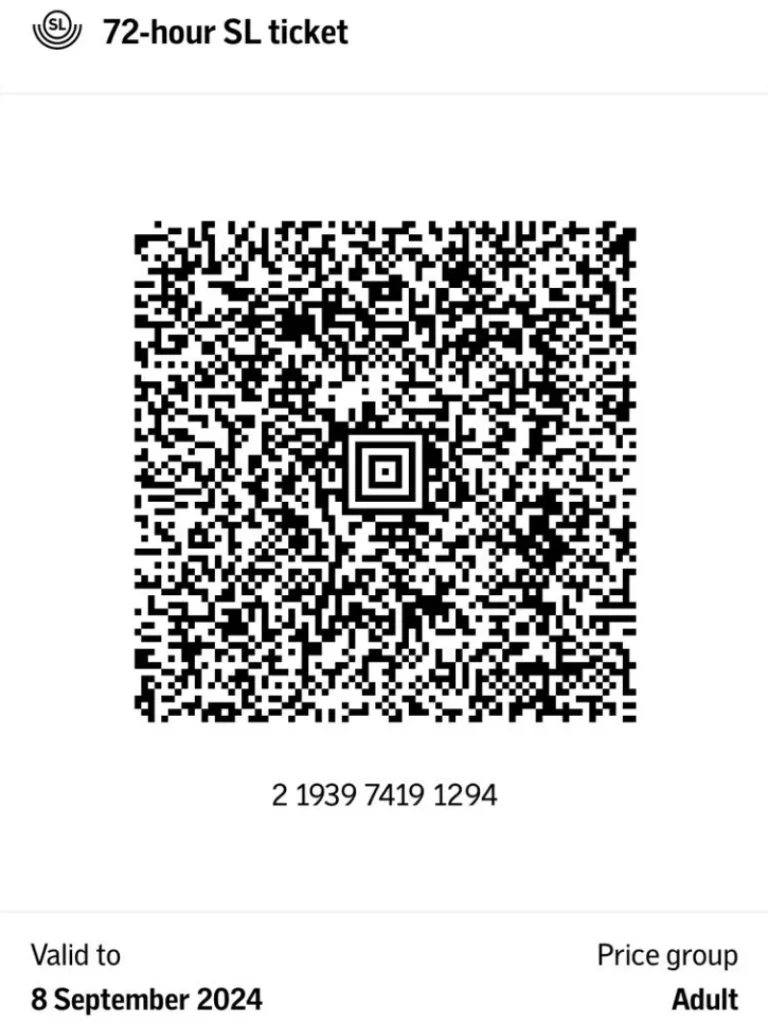
Before our trip in September 2024, we bought 72-hour Travelcards for 350 SEK each. We didn’t activate them immediately, though, as we arrived in Stockholm at around 2 a.m. and took a taxi from the airport to our hotel. On the morning of 4 September, while waiting for our first bus, we activated the Travelcards through the SL app on each of our phones.
We downloaded the SL app before travelling so that we would be ready, and we found it relatively simple to use. In 2024, once we bought the passes, an activation button appeared in the app. The validity period only started once we pressed “activate”, after which our tickets appeared as QR codes. We scanned them near the driver when boarding buses and at the gates when using the metro. We never encountered a ticket inspector during our trip. Since our Travelcards were stored on our phones, we also made sure to always have enough battery to access them.
We stayed at Biz Apartment Gärdet and found it very convenient to have a bus stop right next to our accommodation. Most mornings, we took the bus into central Stockholm and then either explored on foot or took another bus towards our next attraction. We used public transport frequently to get around the city, but having a Travelcard didn’t mean we stopped walking. We still explored extensively on foot, even walking up to 18.8 km in a single day.
What surprised us most was how clean and efficient Stockholm’s public transport was. In our experience, it was one of the easiest public transport systems to use compared with the destinations we had visited at the time. The signs were clear and easy to understand. Whenever we needed help, the drivers we spoke to were able to assist us in English. We were also impressed by the metro stations themselves, particularly the beautifully painted ceilings and artwork.

On the evening of 7 September, we visited Gröna Lund. When checking how to get back to our apartment afterwards, we noticed that a ferry option was included with our Travelcard. We decided to take the ferry instead of the bus that evening, and we weren’t disappointed. It was both practical and an experience in itself. The ride was peaceful, with relatively few passengers, scenic views and seating both inside and outside.

By the end of our trip, we didn’t regret buying the 72-hour Travelcard and felt it had been worth it for us. Looking back, it suited our itinerary because we were staying outside the immediate centre and wanted to move around efficiently to visit the attractions we had planned. However, if we visit Stockholm again, we would still compare the different ticket options based on our itinerary rather than automatically buying another 72-hour pass.
What does an SL Travelcard cover?
According to the official SL website, the Travelcard gives you access to the SL public transport network, including buses, the metro, commuter trains, trams and eligible commuter ferries. However, this doesn’t mean that every ferry, train or other transport service in Stockholm is included, as some are operated separately from the SL network. We recommend checking the official SL website before your trip to confirm exactly which services are covered by your Travelcard.
How to buy and use a Stockholm Travelcard
There are currently two main ways to buy and use a Stockholm Travelcard. The first, and the one we personally used, is through the official SL app. You can purchase your Travelcard in advance, as its validity doesn’t automatically begin when you buy it. Instead, you activate the ticket in the app when you’re ready to start using it.
You can also load a Travelcard onto a physical green SL card. The card itself currently costs 50 SEK if you’re buying one for the first time and can be reused for future trips.
The 24- and 72-hour Travelcards are valid for exactly the specified number of hours. The 7-day Travelcard works differently: it is valid from the day it is activated until 04:30 on the morning after the final day of validity. Travelcards can also be shared with another person, but only one person can travel with the pass at a time. This means you can lend your Travelcard to someone else when you’re not using it, but you can’t use a single Travelcard for two people travelling together.
Does the Stockholm Travelcard cover Arlanda Airport?
If you have a valid SL Travelcard, you can use it on the regular SL commuter train to and from Arlanda Airport. However, passengers over 18 using Arlanda Central station currently need to pay an additional 157 SEK passage fee, even if they already have a valid Travelcard. Passengers under 18 don’t have to pay this fee. The Travelcard does not cover the Arlanda Express, as this is a separate service.
In our case, we didn’t use the Travelcard for either of our airport journeys. We arrived in Stockholm at around 2 a.m. and took a taxi to our accommodation, which cost us 562 SEK in September 2024. By the time we returned to the airport at the end of our trip, our Travelcards had expired, so we used FlixBus instead, which cost us 125 SEK.
Prices and information checked on 15 September 2026. For the latest information, check the official SL website.
SL Travelcard vs Stockholm Pass / Go City
The SL Travelcard is a public transport pass, while the Go City Stockholm Pass is a sightseeing pass that includes a range of attractions and activities around Stockholm.
During our trip, we combined a 72-hour Travelcard with a 48-hour Go City Pass. The two complemented each other very well. Having the Travelcard helped us make better use of our Go City Pass because we could move efficiently between attractions. Keep in mind that these passes aren’t alternatives to each other, as they serve completely different purposes during your trip.
Our verdict: should you buy one?
In our case, we think the Stockholm Travelcard was worth it. It made travelling around the city easier and helped us make the most of our time in Stockholm. Since we were staying outside the immediate centre and moving between several attractions on the same day, we felt that we got good value from our Travelcards.
However, if you’re staying centrally and plan to explore mainly on foot, buying individual tickets may be cheaper. Before buying one, we recommend estimating how often you’ll use public transport and comparing the cost with individual tickets.